Role
Usability testing and wire-framing for the AI tutor's conversational flow.
Worked from research findings toward a design solution.
Project Duration
3 weeks- from problem identification to wire-framing
Team
Product designer (me), Product manger, Software engineer, Developers, and UX Researchers
About Thinkverse
Thinkverse is an AI-driven K-12 math platform that delivers personalized, real-time support to students. It boosts teaching efficiency and provides teachers with key insights
Link to the B2C site (one of the projects I worked on)- Thinkverse Site


Project Overview
This project focused on the AI tutor experience: a chat-based interface where students solve problems with step-by-step guidance from an AI tutor, presented as a persona (Barbie, Mario, Einstein, and others)
Problem: Students Were Talking, Not Solving
The platform had already deployed AI tutor personas to make the experience more engaging for kids. It worked, just not the way it was supposed to. Usability testing showed students were treating the tutor like a character to chat with, not a tool to solve problems with. Session times climbed, but problem-solving progress didn’t.
What Testing Revealed
Running usability sessions with students surfaced a clear pattern: the personas were doing their job too well. Kids enjoyed the back-and-forth with "Mario" or "Einstein" more than they engaged with the actual math. The conversational format, meant to reduce intimidation around problem-solving, was instead becoming the main activity.

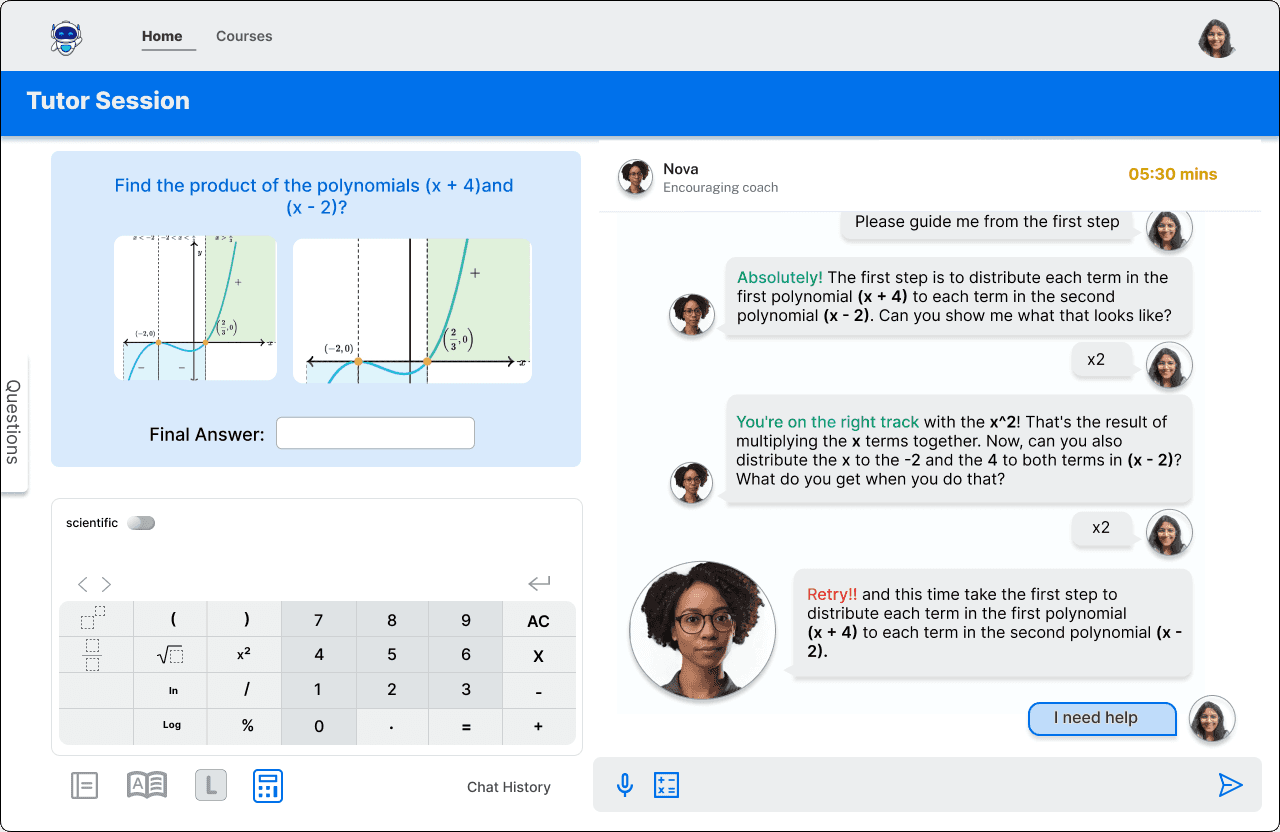
Tutor session wireframe: guided step-by-step chat with math problem, graphs, and conversational support.
Design Decision That Was Made
The wireframed solution introduced a timer tied to the average time it takes a student to solve a comparable problem, not an arbitrary cutoff. The open question: does that timer survive a student switching tutor personas mid-problem?
Resolution, iteration 1: the timer lives in the persistent session header, not inside the switcher panel. It holds through every state below.


This is iteration 1. One open decision I flagged for the team: does the solve-timer persist across a persona switch, or reset? I designed it to persist, since resetting would let students use character-switching as an escape from the exact distraction pattern this redesign addresses. That decision, along with how each persona's AI behavior actually differs, was still being worked through with engineering and ML when I left the project

What this project taught me
Engagement isn't the same as learning. A feature can succeed by every surface-level metric and still miss the actual goal.
Good AI UX for education means designing for outcomes, not just interaction.
Screens From Other Project